Pocket Silicon earns qualifying commissions from merchant links across this page at no extra cost to you. How Pocket Silicon earns affiliate revenue
From pocketable vertical shells to widescreen-adjacent horizontal grips, choosing the right retro portable comes down to button layout, screen comfort, and honest hardware limits.
The budget retro handheld market is packed with hardware variations that share similar silicon under different shells. Between 3.5-inch pocket units and 4-inch horizontal slabs, the experience of playing classic 8-bit, 16-bit, and fifth-generation 32-bit games varies dramatically depending on whether your hands prefer a classic upright Game Boy orientation or ergonomic horizontal shoulders.
Whether you are queuing up classic role-playing games for an urban subway commute or replaying childhood platformers on a park bench, picking the right handheld requires balancing display dimension, stick configuration, and advertised battery specs. Below is a practical breakdown of leading options spanning both horizontal and vertical builds.
Horizontal Form Factors: Extended Grip & Dual Analog Sticks
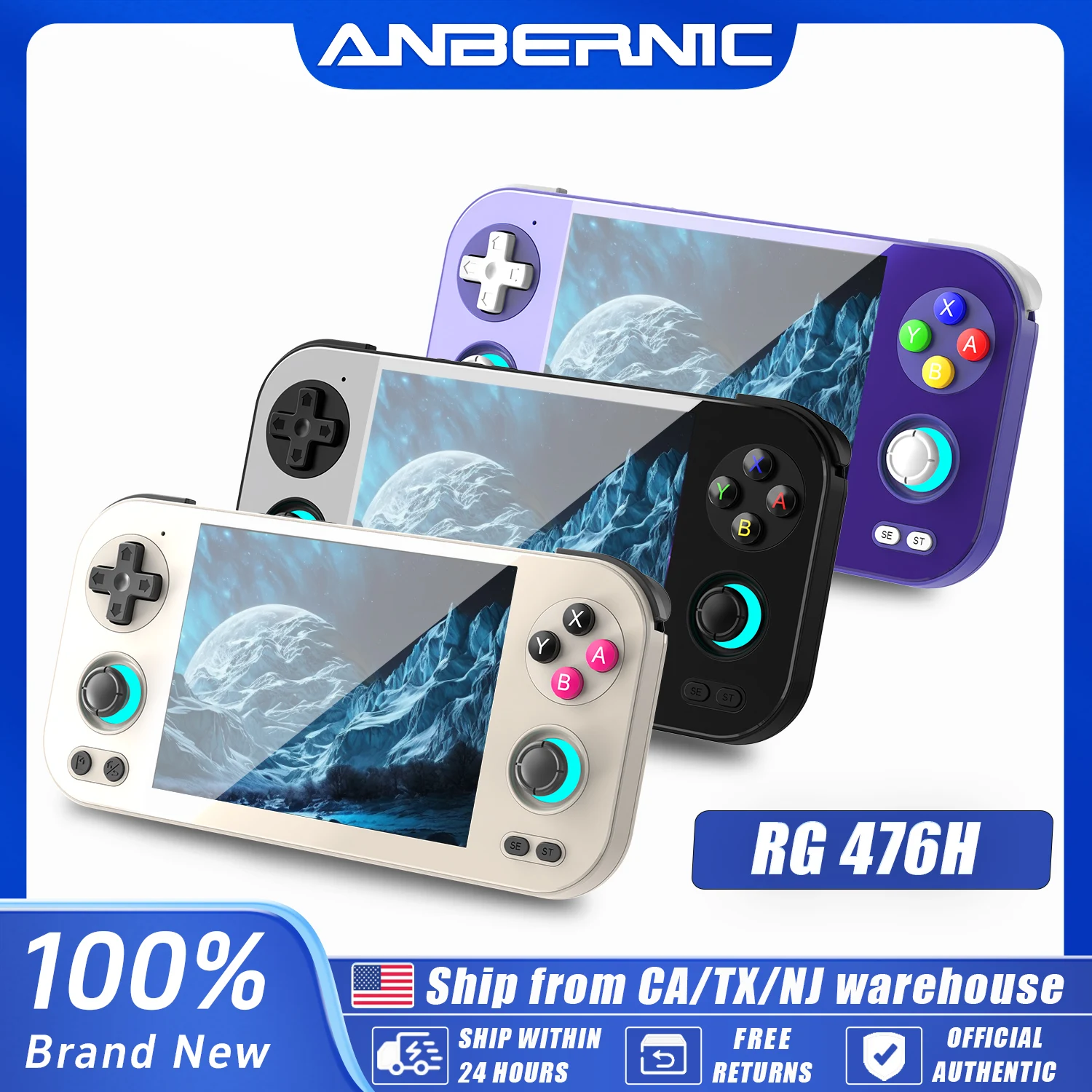
Horizontal handhelds separate the controls to the left and right sides of the display, distributing the center of gravity evenly across two hands. If your gaming routine includes longer continuous sessions or systems designed around thumbsticks—like the PlayStation or arcade brawlers—a landscape orientation reduces wrist cramping significantly compared to compact vertical units.
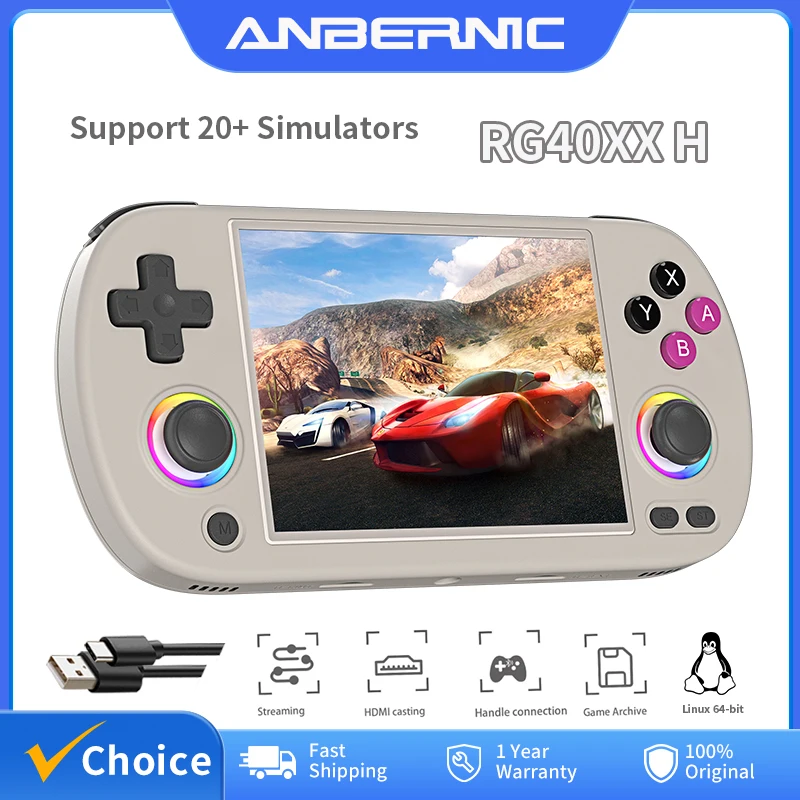
The ANBERNIC RG40XX H stands out by offering a larger 4.0-inch IPS display, stepping up from the ubiquitous 3.5-inch panel found on most sub-$100 portables. Seller specifications state an operating system running on a 64-bit Linux base alongside an advertised 3200mAh battery. The visible layout incorporates low-profile dual analog joysticks accented with RGB lighting rings, paired with an offset D-pad and standard four-button face array.
Who it suits: Commuters and desk gamers who find 3.5-inch panels slightly too cramped for small text or fine pixel grids, and who want twin analog sticks for fifth-generation consoles and arcade ports.
Limitation to note: While the 4-inch display provides noticeably more screen area, the broader chassis is less friendly to shallow jacket pockets than 3.5-inch alternatives. Emulation capability beyond PS1 (such as Dreamcast or N64) should be verified title by title, as Linux H700 platforms generally hit performance caps on demanding 3D titles.
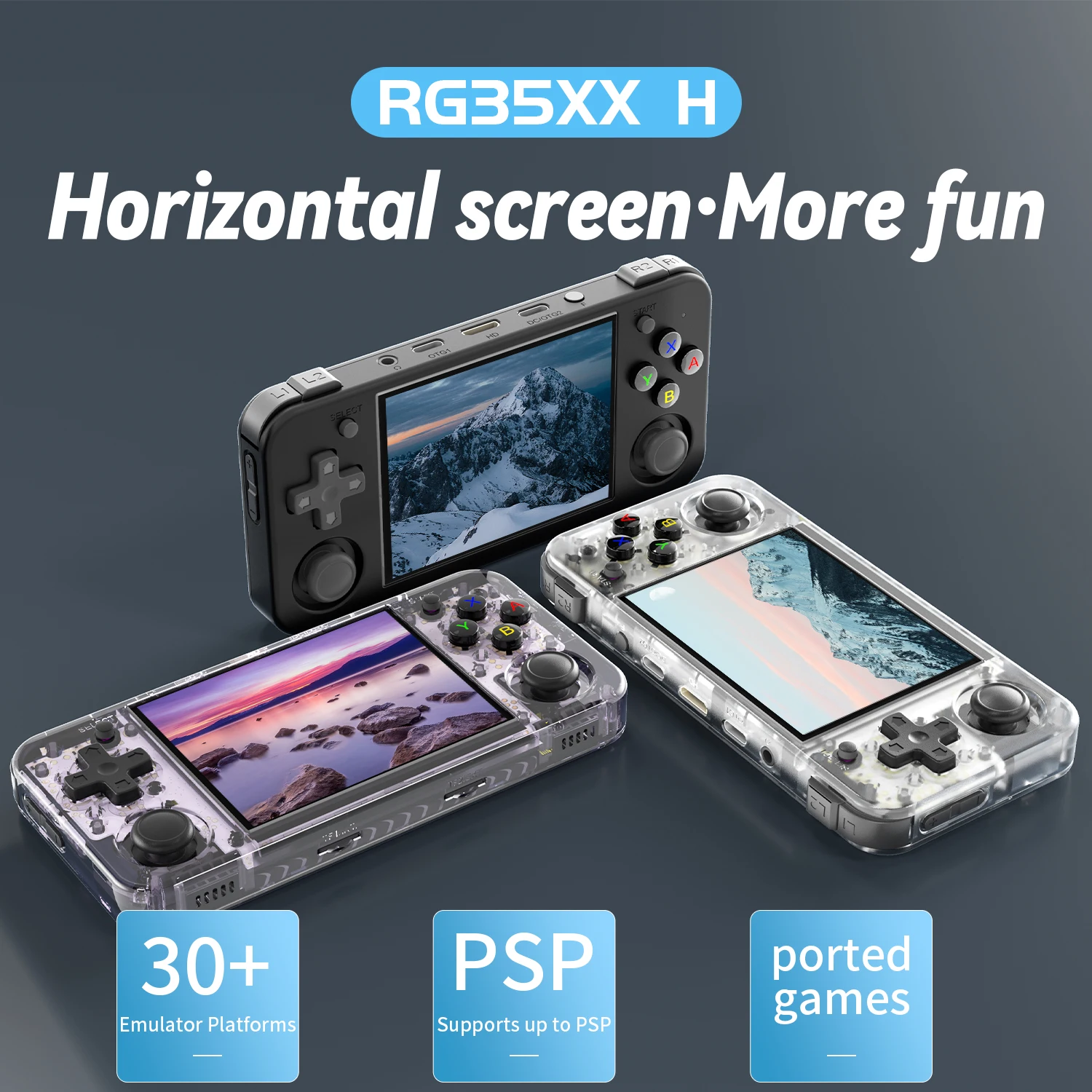
The ANBERNIC RG35XX H balances horizontal ergonomics with true pocketability. Built around a 3.5-inch IPS display and powered by the advertised Allwinner H700 platform, it provides dual analog joysticks set flush into a slim horizontal body. The manufacturer advertises a 3300mAh battery and mini-HDMI output along the top edge, giving you the choice to take quick sessions on transit or hook into an external display at your destination.
Who it suits: Players who want dual analog controls and shoulder buttons in a slender horizontal profile that slips smoothly into an everyday commuter bag without demanding excessive volume.
Vertical Form Factors: Classic Arcade & D-Pad Purity
Vertical consoles capture the unmistakable tactile appeal of the handheld era of the late 1980s and 1990s. With buttons and screen aligned in a single upright block, they excel at one-thumb menu navigation, classic turn-based RPGs, and retro arcade titles where a responsive D-pad is your primary control interface.

The Anbernic RG35XX Plus (RG35XX+) represents the purist approach to vertical handheld gaming. Retaining the nostalgic form factor, it drops analog sticks entirely in favor of an ergonomic D-pad, four action buttons, and rear-mounted trigger curves. Listing claims specify an H700 quad-core Cortex-A53 processor, a 3.5-inch 640×480 IPS panel, and a stated 2600mAh battery capacity with HDMI output.
Who it suits: Retro purists primarily playing NES, Game Boy, SNES, and early PS1 titles that never required thumbsticks, and who prioritize single-handed menu browsing and traditional tactile balance.
Limitation to note: The complete lack of analog sticks means titles with mandatory 3D camera controls or flight sticks will require remapped digital inputs, which may feel awkward on action-heavy arcade titles.
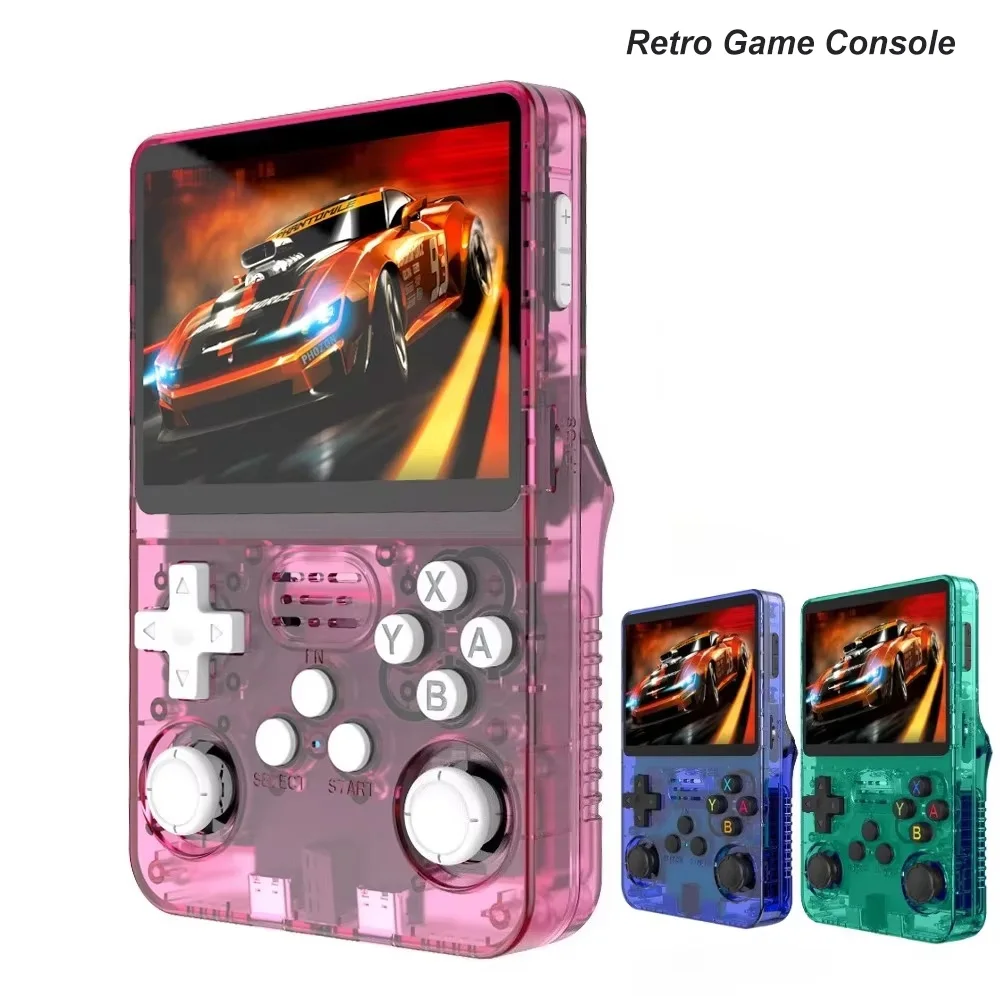
The BOYHOM R36S takes an unusual hybrid route: a vertical body fitted with dual analog thumbsticks placed below the traditional D-pad and face buttons. Listing data points to an ArkOS 2.0 Linux distribution and a 3.5-inch IPS display. Its budget-conscious price tag makes it a popular point of entry for tinkerers willing to manage open-source community firmware.
Who it suits: Shoppers seeking the lowest entry price for an open-source handheld with analog sticks, willing to tweak micro-SD setups and settings manually.
Limitation to note: Placing twin analog sticks at the very base of a vertical shell can force your thumbs into a tight downward angle during extended play sessions. Build finishing and included generic micro-SD cards on budget clones typically benefit from immediate replacement with trusted storage.
Comparison: Stated Specs and Form Factor Differences
The specifications below are compiled from seller listing claims and product packaging data. Battery longevity in practice varies heavily depending on screen brightness, sound volume, and emulation processor load.
Essential Buyer Checklist Before You Order
- Storage Reliability: Many budget consoles ship with unbranded generic micro-SD cards prone to corruption during sudden shutdowns. Budget for a brand-name 64GB or 128GB microSD card to flash the firmware and back up game saves.
- Charging Protocol Safety: Check seller guidance on chargers. Most Linux retro devices require a standard 5V/1.5A or 5V/2A charging brick and a standard USB-A to USB-C cable; using fast-charging USB-C PD (Power Delivery) phone chargers often results in devices failing to negotiate current or overheating.
- Realistic Emulation Targets: Devices powered by chips like the Allwinner H700 or Rockchip equivalents generally provide solid 60 FPS performance for 8-bit, 16-bit, and PS1 libraries. Titles from the Dreamcast, PSP, or Nintendo 64 eras can run with frame-skipping or configuration tweaks, but sixth-generation platforms (PS2, GameCube) lie well beyond the capabilities of this tier.
Editorial note: Specifications, game counts, and dimensions reflect retailer listing claims captured October 2026 and are not independently lab-certified. Always verify package inclusions and return policies directly with the individual store before completing a purchase.